Supremacy: The Game of the Superpowers Review
Listen, modern board games are incredibly polite. You trade sheep, you politely draft cards, you perhaps passively-aggressively block someone from building a medieval textile factory. They are safe.
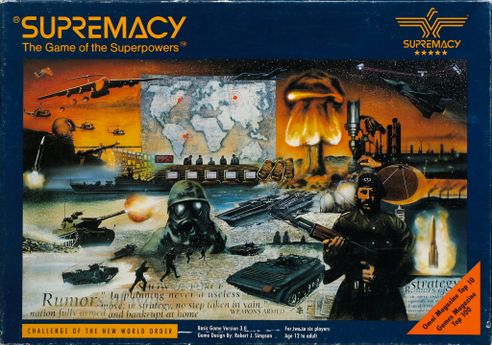
Supremacy: The Game of the Superpowers, designed by Robert J. Simpson and published by Supremacy Games, is a massive, clunky relic from 1984. It is deeply steeped in the paralyzing paranoia of the Cold War. It actively laughs at modern euro-game sensibilities, hands you absolute control over a global superpower, and practically begs you to mathematically monopolize the world’s oil supply. It’s like being invited to a business meeting and discovering the agenda is "Global Domination via Nuclear Winter."
The Economic Blackmail
The core premise is intoxicating. You are fighting for total global domination on a beautifully retro world map. But you do not simply fight with abstract tanks! The true genius—and the absolute terror—lies in its global economic market. There is a physical track representing the global price of Grain, Minerals, and Oil. If you violently invade the Middle East and capture the oil fields, you don't just get points. You literally choke the supply!
The global price of oil physically skyrockets across the entire table. Suddenly, your opponents cannot afford to move their navies because you are aggressively price-gouging the exact fuel they need. The resulting economic blackmail is a friendship-ruining masterclass. It’s a game where the most dangerous weapon isn't a missile, but a well-timed hike in grain prices.
Suitability: Family vs. Friends
Family Sessions
Do not attempt to teach this to your modern, resource-cube-pushing family session. The game is wildly unfair. If someone aggressively corners the global mineral market on turn two, they can essentially economically starve the rest of the table for four grueling hours without firing a single bullet. It’s about as suitable for a family evening as a lecture on 1980s geopolitics.
Hardcore Gamers
For a dedicated group of hardcore history buffs and economic wargame veterans who actively enjoy intensely adversarial cold-war brinkmanship, it is an absolute legendary experience. If you are losing a land war, you can literally just build a nuclear weapon and casually detonate it. But beware! If too many nukes are launched, the climatic threshold is breached, plunging the world into a Nuclear Winter where everybody loses instantly. The sheer tension of staring across the table, finger hovering over a red button, is unmatched.
Pros and Cons
| Pros | Cons |
|---|---|
Dynamic global market mechanic was thirty years ahead of its time. | Economic snowball effect means the wealthy get insanely rich quickly. |
Threatening nuclear strikes for economic trade is incredibly satisfying. | Player elimination means friends might sit staring at a wall for hours. |
Retro, towering plastic mushroom cloud miniatures are terrifying. | Outdated, chaotic combat mechanics occasionally feel clunky and old. |
Final Thoughts
Supremacy is an aggressive, clunky, and utterly fascinating historical artifact. It is not for everyone, but if you have a group that relishes the thought of ruining each other's economies, it is an experience you won't forget.
Final Verdict: Borrow a friend's dusty copy. It is arguably one of the most historically significant thematic designs of the 1980s, but the sheer brutality of its unbalanced capitalism and clunky combat means it is incredibly hard to justify buying at modern vintage markup prices unless you have a severely dedicated group.