Brass Lancashire Review
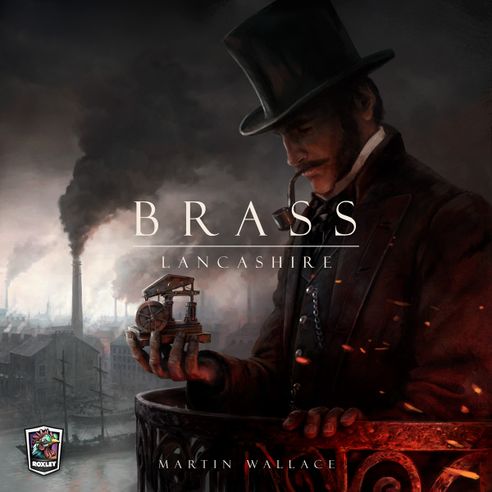
Right. We have completely exhausted the sheer brilliance of Brass: Birmingham in a previous review. But what if you looked at that masterpiece of heavy industrial logistics and thought, "Yes, this is fantastic, but I desperately wish it was significantly meaner, far tighter, and aggressively punished me for making a single tiny mistake regarding my shipping ports?"
Welcome to Brass: Lancashire. Designed by Martin Wallace and published by Roxley Games, it is the older, grumpier, considerably less forgiving sibling that absolutely refuses to apologize when it completely bankrupts your Victorian cotton empire on turn four. Lancashire shares the identical brilliant core engine as its Birmingham successor, but it feels like a heavy Italian supercar with the traction control turned entirely off.
The Industrial Squeeze
You are still slamming down incredibly dark, moody tiles to build coal mines, iron works, and cotton mills during the Industrial Revolution. You are still brutally tearing up your entire beautiful canal network at the halfway point to abruptly replace it with high-speed railway lines. The hand-management puzzle remains flawlessly intact. So what makes the Lancashire box different? The absolute, sheer scarcity of everything.
In Birmingham, if you need to sell your goods, you have multiple diverse avenues and different markets. Lancashire is actively restrictive. You have two options: sell to the incredibly limited local ports dotted around the map, or try to sell to the distant market deck which randomly, violently crashes. The moment your opponent strategically builds a cotton mill and physically consumes the very last available slot in your carefully planned shipping port simply to score their own points, you will experience a level of profound tabletop fury usually reserved for full contact sports.
Suitability: Family vs. Friends
Family Sessions
Do not even approach a casual family setting with this game. If Birmingham was too heavy for Auntie Sue, Lancashire will actively reduce her to tears. The complete lack of external markets forces extreme, ruthless player interaction that borders on economic warfare. It is not a game about "building a nice canal"; it is a game about ensuring your neighbor's canal is entirely useless.
Hard-core Gamers
This is an apex predator game explicitly designed for heavy hardcore veterans who actively relish the opportunity to calculate turn-order manipulation to perfectly snipe the only lucrative coal resource on the entire map. The board is incredibly tight. The economy is perpetually hovering right on the very precipice of absolute collapse. It is a masterpiece of constrained, aggressive economic interaction. For those who think Birmingham is a bit too "cushy," this is the cold, hard reality of the Victorian age.
Pros and Cons
| Pros | Cons |
|---|---|
Noticeably tighter and more aggressively interactive. | The learning curve is brutal; bankruptcy is common. |
The dual-era scoring system is still a masterstroke. | Aggressively dark artwork is often hard to read. |
Streamlined engine by removing the beer mechanic. | Playing with only two players loses some tension. |
Final Thoughts
Brass: Lancashire is the original vision, uncompromised and brutal. It is for the person who wants their economic strategy served with a side of genuine anxiety. It is brilliant, it is beautiful in its own smoky way, and it is entirely essential for the serious collector.
Final Verdict: Borrow a friend's copy. Honestly, unless you exclusively play heavy economic games with an incredibly aggressive group of friends, Brass: Birmingham is the slightly more welcoming, flexible choice. But if you thrive purely on razor-sharp, zero-sum industrial planning, this is the absolute pinnacle.