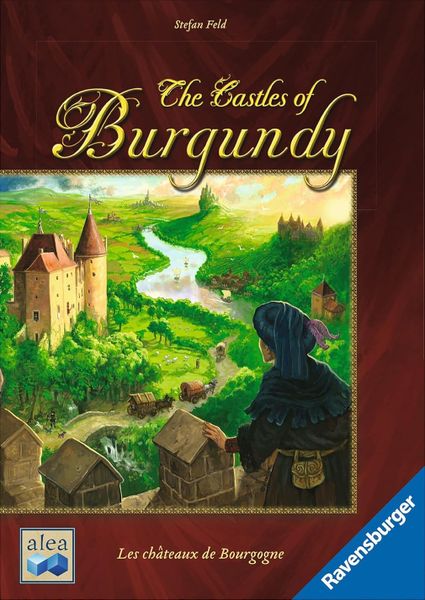
 The most visually washed-out game about incredibly exciting dice manipulation.
Stefan Feld’s absolute masterpiece. The Castles of Burgundy is the quintessential "Euro-game" in its purest, most violently traditional form. If you look at the box, or the board, or any of the hundreds of tiny hexagonal tiles spilled across the table, you will immediately notice that the entire aesthetic palate consists firmly of "muddy beige," "light green," and "faded grey." It looks like an absolutely terrible spreadsheet. It lacks any inherent excitement, plastic figures, or violent player interaction. And yet, if you physically pry this game out of my hands, we will have a serious problem.
The premise is mundane to the point of comedy: you are a French aristocrat in the Burgundy region trying to build a nice estate. You do this by rolling exactly two dice every single turn. That’s it. You roll the dice, and the terrible, punishing luck of the numbers dictates exactly which tiny, hexagonally shaped farm, ship, or castle you can physically pull from the central board and place onto your own personal little estate. It sounds restricting, but it is actually the tightest, most insanely rewarding mitigation puzzle ever designed. You see, you also have "worker" chips. Spend one, and you can literally alter the face of the die. Every turn is a desperate, brain-burning calculation of how to aggressively manipulate a roll of a '3' into a '6' simply so you can drop a silver mine onto your board before your friend does.
The combo potential is frankly outrageous! Placing a single small city tile might instantly grant you a free action, letting you place a castle, which grants you a free technology tile, which instantly generates victory points and causes a chain reaction that results in you triumphantly screaming across the table while your opponents look on in utter disgust. It is a masterpiece of interlocking mechanisms.
Family Session vs. Hardcore Gamers
Surprisingly enough, this works remarkably well for both! Because you only have two dice to worry about each turn, the cognitive load is incredibly manageable, making it fantastic to teach to slightly older children or patient family members. But don't let the simplicity fool you; hardcore gamers will aggressively scrutinize the tile market for an hour, calculating exactly how to deny you the single specific chicken farm you desperately need to complete your pastoral region.
Pros:
- Flawless dice-mitigation mechanics that make every single turn feel extremely rewarding.
- The chain-reaction combo system feels impossibly satisfying to execute.
- Scales wonderfully at two players, making it arguably the best couples game ever.
Cons:
- The color palette is so muted it borders on looking like a printer error.
- Sorting the hundreds of tiny cardboard hexagons is an absolute misery.
- Player interaction is strictly limited to spiteful drafting of specific tiles.
Final Verdict: Buy it yourself. Immediately. Look past the aggressively bland artwork and the terrible components. You are purchasing arguably the slickest, most compelling, heavily tactical dice game ever mathematically constructed.