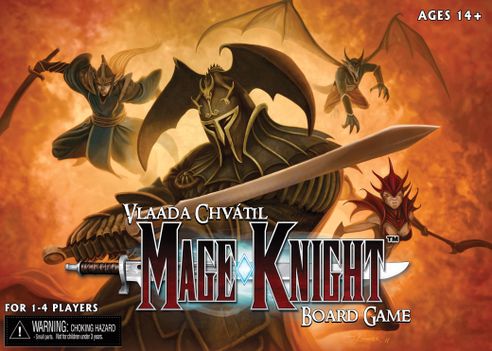
 A fantasy adventure game that mathematically punishes you for casually strolling through a forest.
Listen. Board games about wizards and swords are usually fairly straightforward affairs. You roll a fistful of plastic dice, you aggressively shout at a cardboard goblin, and someone eventually finds a magical ring. But Mage Knight is not a standard fantasy romp. Mage Knight is an incredibly heavy, violently abrasive, hyper-analytical puzzle wrapped in a thick layer of traditional fantasy aesthetics. It is almost certainly the hardest, most cognitively taxing solitaire puzzle you will ever place on a dining table, and it is an unadulterated masterpiece.
The entire game system revolves around managing your deck of incredibly powerful action cards. If you want to move across a swamp, you play a movement card. If you want to brutally siege a heavily fortified keep filled with ice dragons, you play combat cards. Sounds simple, right? Absolutely not. You can play cards sideways to give them a minimal, pathetic boost. You can absorb magical mana from the source pool to supercharge a specific card to god-tier levels of destruction. Every single turn is an agonizing ten-minute mathematical equation where you desperate try to calculate if you have exactly 13 siege damage to cleanly eradicate an Orc fortress without taking a single wound card into your precious hand. It is brain-burning! You will literally stare at the physical board until your vision goes completely blurry.
The sense of progression, however, is staggeringly unmatched. You start the game terrified of relatively weak marauding orcs. By the final day-and-night cycle, you are commanding an entire army of elite Utem Guardsmen, dropping literal meteors onto cities, and aggressively burning entire monasteries to the ground just to steal their artifacts. The sheer, terrifying power scaling of your character is completely addictive, provided you have the intellectual fortitude to actually calculate the damage properly.
Family Session vs. Hardcore Gamers
Do not even look at this game if your family is visiting. Don't even talk about it. The rulebook is notoriously bifurcated into a “walkthrough” guide and a "reference" guide, both of which are thick enough to stop a bullet. Calculating resistances, armor values, brutal attacks, and elemental blocks will actively make casual players cry. This is explicitly, primarily designed as a hardcore solitary experience! While you can play it with up to four people, doing so turns a three-hour math puzzle into an agonizing twelve-hour waiting room. Play it solo or strictly with one incredibly patient friend.
Pros:
- Hand-down the undisputed champion of heavy solo-board gaming. Pure puzzle perfection.
- The arc of progressing from a weak wanderer to a god-like siege engine is flawless.
- Deep, thematic mechanics that combine deck-building with heavy tactical spatial movement.
Cons:
- Playing with any more than two people is a completely miserable exercise in waiting.
- The rulebooks are dense, confusing, and constantly require mid-game referencing.
- Setup takes a terrifyingly long time and consumes massive amounts of table space.
Final Verdict: Buy it yourself. If you are entirely comfortable sitting at a table alone for three hours, wrestling with complex math and brutal hand management, it delivers the most deeply satisfying puzzle in the history of the fantasy genre.