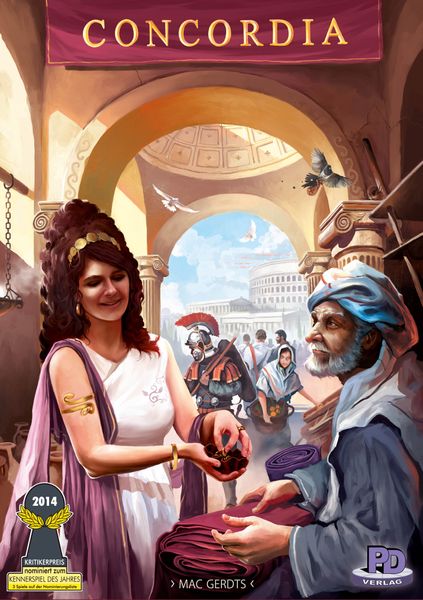
 Selling cloth in ancient Rome has never been this mathematically graceful.
Right, look at this box. Be honest. Upon seeing it, you probably thought you were looking at a dry, dusty educational tool designed to punish unruly teenagers during history classes. Concordia’s cover art is legendary for being one of the most aggressively uninteresting things ever committed to cardboard. But beneath that desperately beige façade lies arguably the most elegant, smooth, and flawlessly designed trading-in-the-Mediterranean board game ever created by human hands. It is the absolute definition of not judging a book by its incredibly boring cover.
The rules of Concordia can fit on a single, sensible sheet of paper. On your turn, you simply play a card from your hand and do what it says. That is it. No dice. No elaborate phases. You play the ‘Architect’ to move colonists and build tiny houses. You play the ‘Mercator’ to aggressively sell cloth and buy wine like an absolute Roman hedonist. But the sheer brilliance of the design is that every card you play is locked down on the table until you explicitly waste a turn playing an awful card called the ‘Tribune’ to pick them all back up again. It completely eliminates analysis paralysis because your options naturally shrink over time. You are forced to optimize an increasingly desperate string of actions to maximize efficiency. It flows like poetry!
And then there is the end-game scoring mechanism. It is fundamentally, beautifully hidden. The cards you are buying to expand your action pool throughout the game are secretly dictating exactly how many points you will earn at the end for your expanding empire on the map. It creates an incredible tension because absolutely nobody knows who is actually winning until the final five minutes! You might feel incredibly smug about your sprawling wine monopoly in Greece, only to realize the person quietly buying Minerva cards has mathematically buried you entirely in silence.
Family Session vs. Hardcore Gamers
Is this a family game? Miraculously, yes! Despite originating in the heavy euro-game stratosphere, the "play one card a turn" mechanic makes teaching it incredibly easy. Anyone can understand it within five minutes. However, underneath that simple exterior is a deeply rich strategic puzzle that your hardcore gaming friends will happily spend hours optimizing. It is the ultimate bridge game.
Pros:
- Incredibly smooth, lightning-fast turns. There is literally zero downtime.
- Teaching the mechanics takes exactly three minutes, masking incredibly deep strategy.
- The hidden deck-based point system keeps tension extraordinarily high until the end.
Cons:
- The box art looks like a discarded textbook from the early 1990s.
- Scoring the game perfectly at the end is an agonizing mathematical chore.
- Interaction is mostly just politely paying someone a few extra coins.
Final Verdict: Buy it yourself. Instantly. It is a triumph of elegant game design that proves you do not need 500 plastic miniatures or complex dice systems to create a massively engaging, deeply satisfying strategic experience.