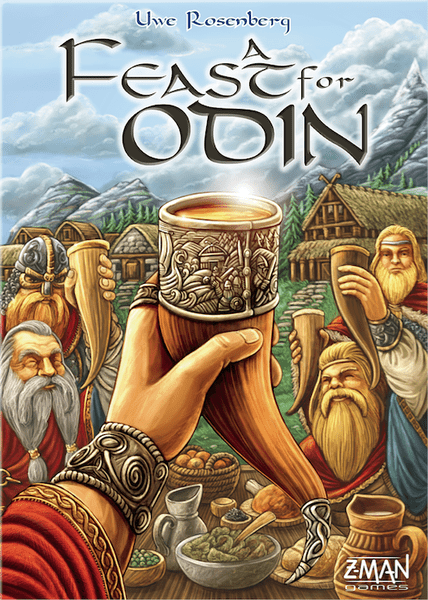
 Because true Vikings prefer extreme logistics puzzles over actual combat.
When someone invites you to play a game called ‘A Feast for Odin’, you naturally expect a chaotic afternoon of rolling fistfuls of dice, aggressively raiding coastal European monasteries, and violently throwing massive plastic mead horns at your friends. What you actually get is a brain-melting, three-hour logistical spreadsheet where you desperately try to fit irregularly shaped cardboard cheese and violently orange woolen socks into a grid to avoid getting negative points. It is essentially Tetris combined with historically accurate Viking agriculture, and it is undeniably glorious.
Designed by Uwe Rosenberg, the undisputed king of making you panic about feeding your imaginary German peasants, this game ramps up the sheer volume of choices to an almost comical extreme. The central action board does not have five options. It doesn't have ten. It has over sixty unique worker placement spots. The first time you look at the board, you will experience actual, physical vertigo. You can go whaling! You can migrate to Iceland! You can peacefully knit a sweater! Or you can spend roughly twenty minutes agonizing over whether it is mathematically optimal to breed your sheep or convert a cow into an appropriately shaped piece of beef to satisfy the Viking feast. The breadth of strategy is entirely paralyzing.
But the absolute core of the game—the spatial puzzle—is what elevates it to masterpiece status. You have player boards covered in negative point values. The only way to win is to acquire awkwardly shaped loot—iron ore, stolen silver, cured meats, and runestones—and perfectly tessellate them onto the grid without leaving a single gap. The crushing intellectual satisfaction of finally managing to perfectly slot a massive piece of stolen English silverware directly next to a small wooden cabin, flawlessly completing a row and immediately gaining an income of three silver coins, is perhaps one of the most powerful dopamine hits in the entire hobby.
Family Session vs. Hardcore Gamers
Do not attempt to introduce this to casual players unless you specifically want them to immediately leave your house. The setup alone involves organizing dozens of plastic trays filled with hundreds of tiny cardboard beans, flax, and meat tokens. It will terrify your relatives. However, for a dedicated hardcore group, this is an absolute banquet of brain-burning optimization. It is dense, it is remarkably low-conflict (you simply take a spot someone else wanted), and it is wildly addictive.
Pros:
- The spatial Tetris-style puzzle provides an outrageously satisfying gameplay loop.
- There are an infinite number of paths to victory and weird strategies to explore.
- A remarkably peaceful, multi-player solitaire game about bloodthirsty Viking raids.
Cons:
- The sheer volume of 60+ action spaces will aggressively trigger analysis paralysis.
- Setting it up is practically a part-time job involving endless plastic trays.
- The physical footprint of the game requires an uncomfortably massive table.
Final Verdict: Buy it yourself. It is arguably the magnum opus of the heavy worker-placement genre. It completely subverts the Viking theme and delivers an intensely rewarding, deeply satisfying geometric puzzle that will absolutely consume your entire afternoon.