Scout Review
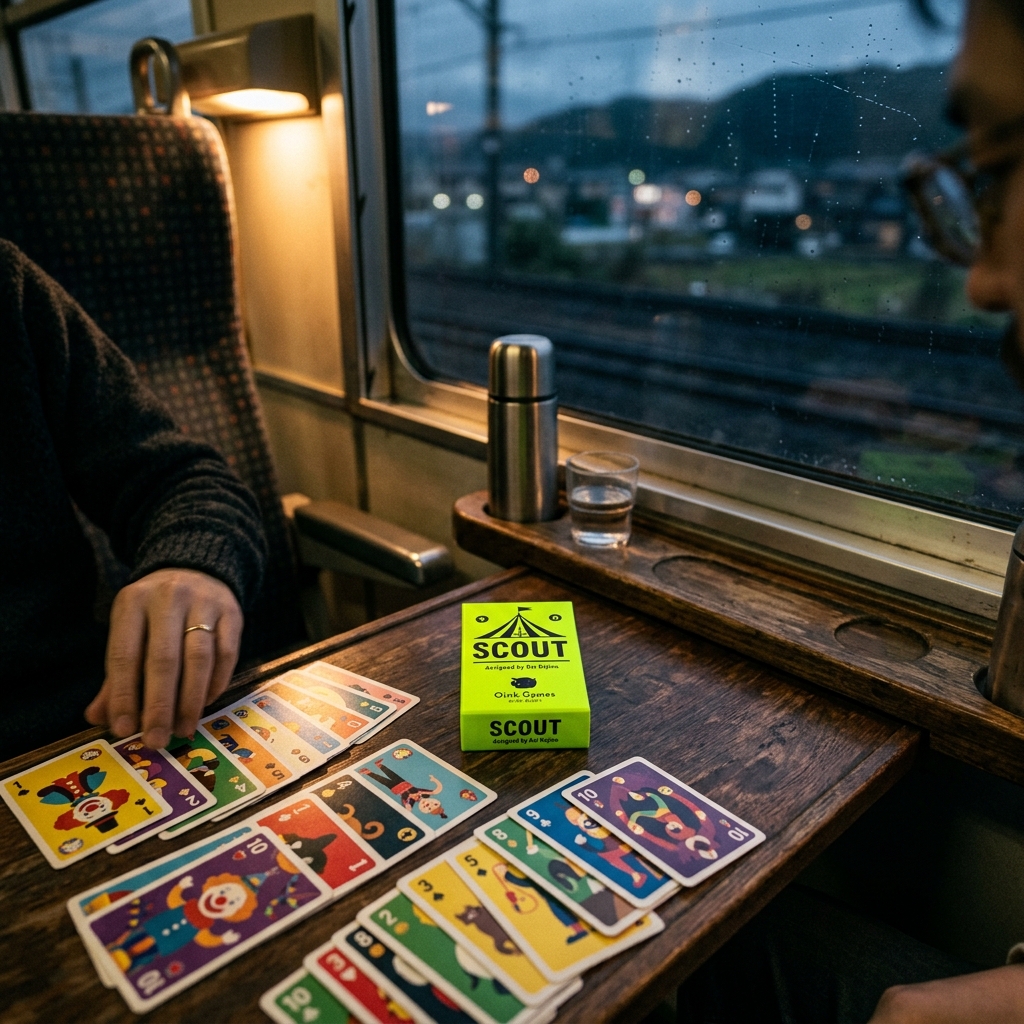
The quintessential modern problem with board games is bloat. We live in an era where designers seem biologically incapable of putting fewer than three hundred plastic miniatures and a fifty-page rulebook into a box. Enter Scout, a game packaged in a box so unnervingly small that you could accidentally inhale it if you breathe too heavily.
Designed by Kei Kajino and published by Oink Games, it is a ladder-climbing card game with a twist that is so elegant it makes you actively angry that you didn't think of it yourself: you cannot rearrange the cards in your hand. It’s like being asked to organize a circus while your hands are superglued to a pair of moderately heavy bricks.
The Circus Constraint
You are dealt your hand, and you are stuck with it. The physical arrangement of the cards as you picked them up is the exact order they must remain in. Your goal is to beat the current "set" on the table. If you cannot beat it, you must "Scout," which means taking a card from either end of the active set and adding it to your hand wherever you like.
This forced physical constraint turns what could be a mundane game of higher-or-lower into an absolute masterclass of hand management and situational awareness. Every single time you draw a card, you are faced with a minor existential crisis about whether flipping your entire hand upside down (which the game allows you to do exactly once) is the key to victory or a devastating act of self-sabotage. It’s brilliant, it’s loud, and it’s fast.
Suitability: Family vs. Friends
Family Sessions
Magnificent. The rules take roughly eighty seconds to explain, and there is zero text on the cards to confuse younger players. The tiny footprint means it can be played on absolutely anything—a coffee table, an airplane tray, or a particularly flat rock in the middle of a rainstorm. It’s the ultimate "just one more game" family experience that fits in a coat pocket.
Hardcore Gamers
Do not pull this out if your friends came over expecting to spend four hours optimizing trade routes in medieval Germany. However, as a filler game while ordering pizza or waiting for the slow-coach of the group to finish their turn in Twilight Imperium, it is lethal and incredibly competitive. The depth of strategy for such a tiny deck is genuinely staggering, providing more agonizing tension than most massive Kickstarter behemoths.
Pros and Cons
| Pros | Cons |
|---|---|
Unbelievably deep strategy for a tiny deck of cards. | The scoring tokens are comically tiny and easy to lose. |
The constraint of "no rearranging" forces agonizing decisions. | Two-player variant misses the chaotic magic of 4 players. |
Fits seamlessly into a coat pocket; ultimate portability. | The circus theme is completely irrelevant to the gameplay. |
Final Thoughts
Scout is one of the smartest, sleekest little card games produced in the last decade. It delivers more agonizing strategic tension in fifteen minutes than most massive Kickstarter behemoths provide in an entire weekend. It’s a masterclass in minimalist design that belongs in every collection.
Final Verdict: Buy it yourself. Scout is one of the smartest, sleekest little card games produced in the last decade. It delivers more agonizing strategic tension in fifteen minutes than most massive Kickstarter behemoths provide in an entire weekend.