Air, Land, & Sea Review
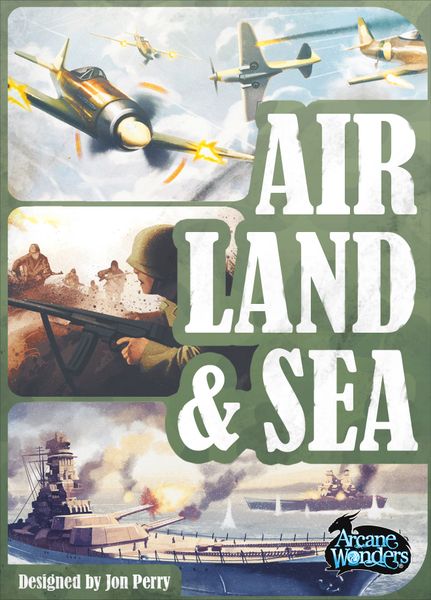
There is no shortage of twelve-hour World War II simulations that require a table the size of an aircraft carrier. Air, Land, & Sea, published by Arcane Wonders, looks at that tradition, laughs heartily, and decides to simulate the entire global conflict using exactly eighteen cards.
It is a two-player, lane-battling game that distills grand strategy into a microscopic footprint. It’s like being the star of a very high-stakes military thriller where the only thing that matters is how well you can bluff your opponent with a single card. It is a work of pure, unadulterated minimalist genius.
The Lane-Battling Duel
Three "theaters of war" (Air, Land, and Sea) are laid out between you. You have a hand of six cards. You play one card per turn to its matching theater to increase your strength. The genius lies in the card powers and the ability to play cards face down. Every card has a unique, rule-breaking ability if played face up.
However, any card can be played face down as a blank 2-strength card. This allows for immense bluffing. More importantly, it features a "withdrawal" mechanism. If your hand is terrible, you can surrender early and minimize the victory points your opponent gains. It introduces a poker-like dynamic of knowing when to hold them and when to fold them. Every play feels critical, and the ability to retreat means you are constantly evaluating risk.
Suitability: Family vs. Friends
Family Sessions
Probably a bit dry for younger kids who want colorful plastic figures. The theme is austere and the gameplay is purely tactical card play. It’s intense, but not particularly "fun" in the traditional family sense. It’s the sort of game that makes everyone feel like they're in a very high-stakes war room, which might not be the mood for a lighthearted Sunday afternoon.
Hardcore Gamers
An absolutely brilliant two-player duel. The strategic space generated by just eighteen cards is frankly absurd. Every play feels critical, and the ability to retreat means you are constantly evaluating risk-versus-reward. It can be played entirely within the footprint of three playing cards, making it the perfect travel game for a robust two-player tactical duel on a sticky tray table.
Pros and Cons
| Pros | Cons |
|---|---|
Massive tactical depth condensed into only 18 cards; design perfection. | The artwork and theme are extremely dry and purely functional. |
Bluffing and early-retreat mechanics provide superb poker-like tension. | Learning curve for utilizing card powers efficiently can be steep. |
Can be played entirely within the footprint of three playing cards. | It is strictly a two-player experience; zero potential for more. |
Final Thoughts
Air, Land, & Sea is a phenomenally tight design. It is fast, tense, and incredibly rewarding for those who enjoy a bit of high-stakes psychological warfare. For the price of a couple of coffees, you are securing a masterclass in tactical minimalism.
Final Verdict: Convince a friend to buy it. It is a phenomenally tight design, but the incredibly austere theme means it won't appeal to everyone. Have your mate buy it so you always have a robust two-player tactical duel on hand for when you are stuck in a transit lounge.